How to find your tyre size?
You can find the correct tyre size in a matter of seconds - it is marked both on the tyre itself and in several places on the car.
1. Where to find the tyre size

- Tyre sidewall - every tyre has the full size code printed on it, for example 205/55 R16 91V. The most reliable source.
- Door frame (driver's side) - open the driver's door and you will find a sticker on the door frame with the manufacturer's recommended size and air pressure.
- Owner's manual - always found in the handbook section on wheels or technical data.
- Fuel filler cap - on some car models the tyre size is also shown on the inside of the fuel cap.
Tip: Always check that the size recommended on the car matches the tyres actually fitted. If the car's rims have been changed, the size may differ from the manufacturer's recommendation.
2. How to read the tyre size code
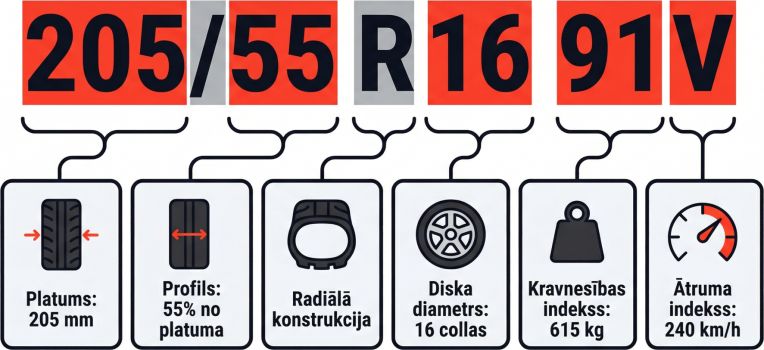
Example: 205/55 R16 91V
- 205 - tyre width in millimetres (from sidewall to sidewall)
- 55 - profile height as a percentage of the width (205 × 0.55 = 113 mm)
- R - radial construction (not radius)
- 16 - rim diameter in inches
- 91 - load index (91 = 615 kg per tyre)
- V - speed rating (V = 240 km/h)
Important: The letter R does not stand for "radius" - this is one of the most common mistakes. R denotes the tyre's radial construction.
Load index
| Index |
Max. load |
Index |
Max. load |
| 82 |
475 kg |
91 |
615 kg |
| 84 |
500 kg |
94 |
670 kg |
| 86 |
530 kg |
96 |
710 kg |
| 88 |
560 kg |
98 |
750 kg |
| 90 |
600 kg |
100 |
800 kg |
Important: Never fit tyres with a lower load index than specified by the car manufacturer.
Speed rating
| Index |
Max. speed |
Index |
Max. speed |
| T |
190 km/h |
W |
270 km/h |
| H |
210 km/h |
Y |
300 km/h |
| V |
240 km/h |
(Y) |
>300 km/h |
Tip: Winter tyres may have a speed rating one grade lower than summer tyres.
3. Season markings
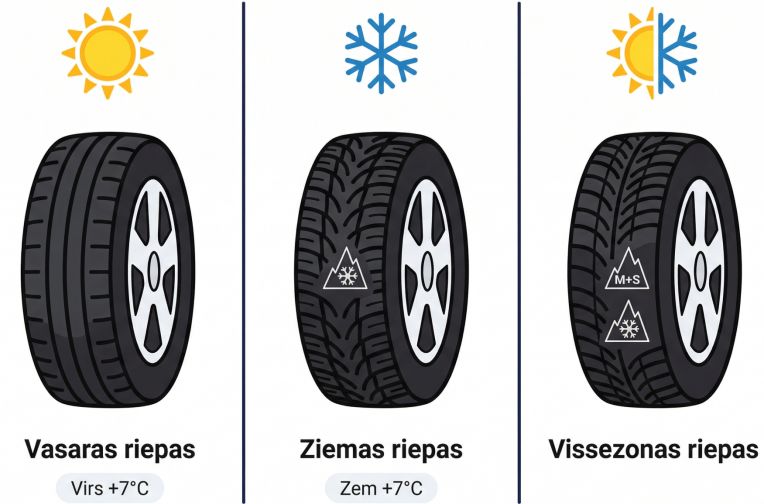
- Summer tyres - no M+S or 3PMSF marking. Perform best at temperatures above +7°C.
- Winter tyres - carry the 3PMSF symbol (a mountain with a snowflake ❄). A softer rubber compound and a deeper tread with sipes. Designed for temperatures below +7°C.
- All-season tyres - usually carry both the M+S and 3PMSF markings. A compromise between summer and winter tyres.
M+S - mud and snow
The M+S marking indicates an improved tread for mud and snow, but M+S is the manufacturer's own declaration with no mandatory testing. M+S alone does not guarantee genuine winter performance.
3PMSF - mountain with a snowflake
The tyre has passed a standardised braking test on packed snow and delivers at least 25% better grip than the reference tyre. These are genuine winter tyres.
In Latvia: Winter tyres are mandatory from 1 December to 1 March. Studded tyres are permitted from 1 October to 1 May.
4. Run-flat tyres
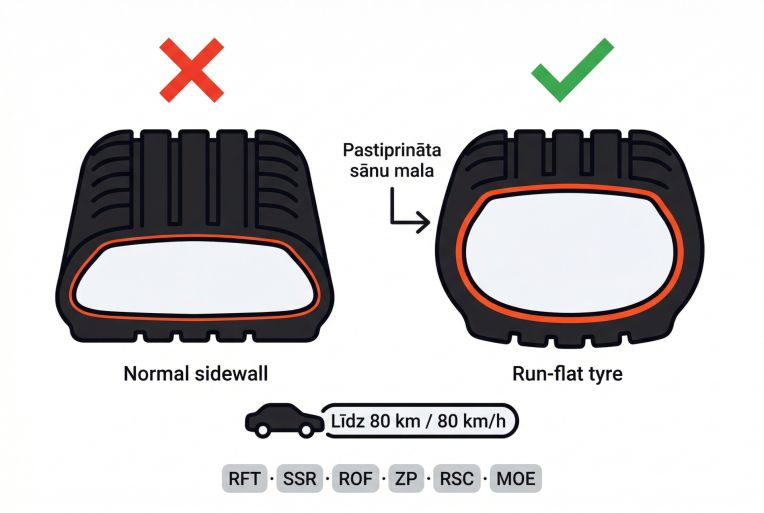
Run-flat tyres with reinforced sidewalls let you keep driving after a complete loss of air pressure - typically up to 80 km at speeds of up to 80 km/h. Common on cars without a spare wheel.
| Marking |
Manufacturer |
| RFT |
Bridgestone |
| SSR |
Continental |
| ROF |
Goodyear, Dunlop |
| ZP |
Michelin |
| RSC |
ISO standard (often BMW / MINI) |
| MOE |
Mercedes-Benz |
| HRS |
Hankook |
| Run Flat |
Pirelli |
Important: Run-flat and conventional tyres must never be combined on the same axle - this compromises handling and safety.
5. EU tyre label
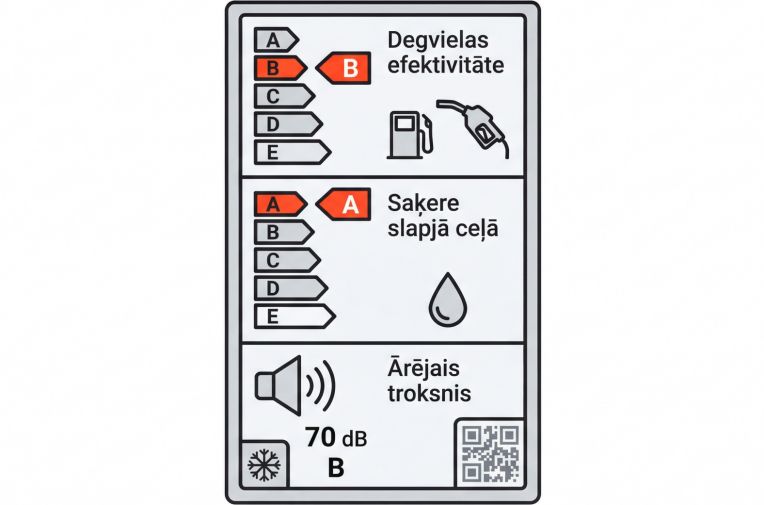
Since 2021, all new tyres sold on the EU market must carry a standardised label. It rates three parameters:
- Fuel efficiency (A–E) - class A tyres can save up to 7.5% of fuel compared with class E. Tyres account for 20–30% of total fuel consumption.
- Wet grip (A–E) - the difference between classes can mean 3–6 metres of extra stopping distance in an emergency stop from 80 km/h.
- External rolling noise (dB, A–C) - A is the quietest, C the loudest. Affects driving comfort and the surrounding environment.
The label may also carry additional symbols:
- Snowflake icon - the tyre meets 3PMSF requirements
- Ice icon - tested on ice (Scandinavian conditions)
- QR code - full details in the EU EPREL product database
6. Other markings on the tyre sidewall
- DOT code - the last 4 digits show the date of manufacture. For example, 2523 = week 25 of 2023. Manufacturers recommend replacing tyres after 6–10 years.
- XL / Extra Load - reinforced construction for higher loads. Intended for heavier vehicles.
- TWI (▲) - tread wear indicator. When the tread wears level with this marker (1.6 mm), the tyre must be replaced immediately.
- ROTATION / arrow - a directional tyre must rotate in the specified direction. The arrow must point forwards.
- OUTSIDE / INSIDE - on asymmetric tyres OUTSIDE must face outwards and INSIDE inwards. Incorrect fitting reduces grip.