If you take your car to the track at weekends, drive autoslalom or hillclimb events and want the greatest possible grip on dry asphalt, semi-slick or sport tyres are the segment you're looking for. This is the most extreme category of road-legal tyres - a nearly smooth tread and a soft, sticky rubber compound that delivers full grip only once warmed up. They are made for sport and tuned cars with uprated suspension, not for everyday driving. Below are the summer models available in our stock, in a wide range of sizes.
Semi-slick and sport tyres
Maximum grip on a dry track for track-day driving, autoslalom and drifting - summer tyres for sport and tuned cars.
7 tyre models available
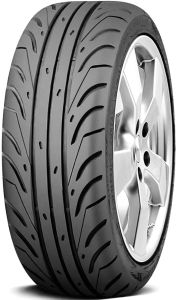

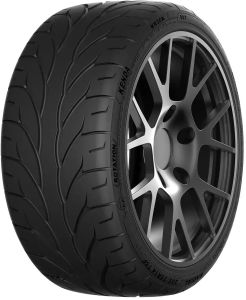




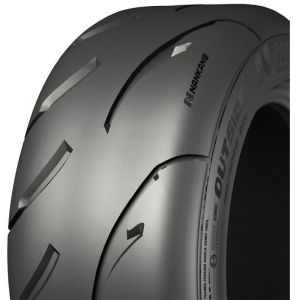

Tread and construction: what semi-slicks deliver on the road
Semi-slick tyres are recognisable by their tread - it's almost smooth, with a few wide grooves, just enough to keep the tyre road-legal (E-marking or DOT). Fewer grooves mean more rubber on the asphalt and greater mechanical grip in dry conditions. That same construction is also why these tyres channel water poorly on a wet road and the risk of aquaplaning rises sharply. The rubber compound is soft and sticky, so it fully grips the road only once warmed up - cold tyres feel slippery and the braking distance on the first few laps is far longer.
The main thing a buyer needs to decide is compound hardness: soft, medium or hard.
- Compound. A softer rubber compound gives more grip but wears faster; a harder one lasts longer but grips less. On the sidewall, find the treadwear (UTQG) number - for a semi-slick it tends to be around 100-200, while a regular UHP summer tyre is 300 or more.
- Warm-up. Maximum grip only kicks in at roughly 80-100 °C tread temperature. On a short city drive the tyre may never reach its working temperature, so it's no good for everyday use.
- Reinforced construction. Most of our semi-slick models carry the XL marking - a stiffer casing withstands higher loads during fast driving, but rides harder and is noisier on rough asphalt.
- Load index and speed rating. These tyres often carry high speed ratings (240 km/h and above), but the load index must not be dropped below the car manufacturer's requirement. Buy correctly, per axle and in sets.
- Marking. E or DOT means road-legal; the wording NHS ("Not for Highway Service") - track only. Check it before you buy.
Our segment includes budget and mid-range sport tyres from Nankang, Toyo, Yokohama, Accelera and Kenda, and some models are especially suited to drifting. If track days aren't your goal, a more sensible everyday choice is a UHP summer tyre.
Frequently asked questions
Most semi-slick models have an E-marking or DOT, so they are road-legal. Check the sidewall: if it shows the wording NHS ("Not for Highway Service"), the tyre is intended for the track only and must not be used on public roads.
No. They are not M+S and never 3PMSF, so during the Latvian winter period (from 1 December to 1 March, when the 3PMSF marking is mandatory) they must not be used. In the rain, too, grip is much weaker than on a regular road tyre, so before winter you need a separate 3PMSF winter or all-season set.
Depending on the compound and driving style, roughly 5,000-30,000 km. Heavy track use can wear a soft compound down to the cord in a few thousand km, whereas relaxed driving on a harder compound lasts considerably longer.
A UHP summer tyre is a sensible everyday sporty choice - good grip in both dry and wet conditions, a longer life and it works without warming up. A semi-slick trades all of that for extra grip on a dry track and needs heat to work at all.
Yes, that's exactly what they're made for - to drive to the track, run your sessions and return on the same tyres. Bear in mind that they perform much worse when cold and wet, so be careful on the way to the track.
A soft compound grips best but wears quickly and holds its peak for only a few heat cycles, so it suits competition laps. A medium or harder compound is more durable and better suited to regular track days; the treadwear number on the sidewall tells you a lot about this.
Special tyre categories
Niche tyre segments for specific applications - from all-terrain and sports tyres to seasonal and technology-focused tyres.