Enter a corner sideways, with the rear axle spinning faster than the road and smoke pouring off the tyre - this is exactly what drift tyres are built for. It isn't a separate factory category but a setup approach: hard sports tyres made for dry tarmac, fitted mainly on the rear axle as a consumable. In our range they come from budget and performance brands - Accelera, Kenda and Nankang - in a range of widths and rim sizes, and all these models are summer tyres.
Drift tyres
Hard summer sports tyres for rear-wheel-drive cars and track day drivers.
4 tyre models available
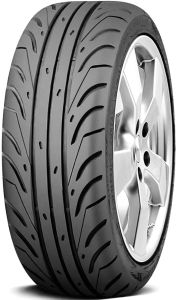

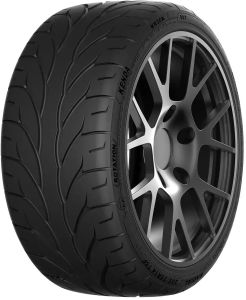



Construction and tread: what sets a drift tyre apart
What sets a drift tyre apart is the compound and the casing, not the tread pattern. During a slide the rear axle spins considerably faster than the road and gets very hot. The rubber has to withstand sustained heat without failing, so a hard, high-treadwear compound goes on the rear: it slides predictably and lasts longer, and it costs less than soft rubber. The front is chosen on the opposite principle - a softer compound and deeper tread, so the car actually steers where you want it to.
In practice this means the front and rear are set up separately. Here's what the fitter looks at first.
- Compound hardness. The rear needs a higher-treadwear rubber, and the more powerful the car, the harder it should be, so it can spin the tyre without scrubbing it away too fast.
- Sidewall stiffness and profile. A stiff sidewall resists the tyre rolling over at large slide angles and gives a quicker, more predictable response; lower profiles reinforce this.
- Casing strength. The tyre is put under enormous lateral loads, so a tough bead matters, to keep the rubber from coming off the rim mid-run.
- Sizes and indices. Many drift with a wider rear than front (staggered) - match the sizes to your rims and check clearance, but don't skimp on the load index, since a hard tyre still carries the axle load.
In our range widths run from 195 to 305 mm and rims from R15 to R20, with a focus on R17-R18. Most sizes carry high speed ratings of W or Y, and the majority of models are also available with an XL reinforced casing.
Frequently asked questions
Mainly on the rear. RWD cars drift on the rear axle, so hard, consumable tyres go there, while the front usually gets a grippier tyre to hold the steering line.
Grip, or semi-slick, tyres use a soft compound to maximise grip and lap time. A rear drift tyre needs the opposite - less grip and a predictable slide, so a harder, cheaper rubber is chosen. At the front the two segments overlap, because grip still matters there.
No. Every model in this segment is a summer tyre with no 3PMSF or winter marking. In the cold the hard compound gets even harder, and on snow or ice they barely work; the best results come in the warm season, above roughly +7 degrees.
Most are E-marked road tyres, but in Latvia winter tyres are mandatory from 1 December to 1 March (minimum tread depth 4 mm), so a summer drift tyre may not be used on public roads during that period. Some track tyres aren't road-legal at all - check the sidewall marking.
Rear-wheel-drive platforms - classics like the Nissan Silvia/200SX/350Z, the BMW 3 Series (E30/E36/E46), the Toyota GT86 or Supra, the Mazda MX-5/RX-7 and similar. The buyer is usually an enthusiast or track day driver, not an everyday motorist.
The rear is a consumable, so it's changed often. At professional level a set can wear out in roughly a single competition run; on amateur track days it lasts longer, but its life is still short compared with an everyday tyre.
Special tyre categories
Niche tyre segments for specific applications - from all-terrain and sports tyres to seasonal and technology-focused tyres.